Sustainability Isn't a Buzzword — It's Our Business Model
Every IBC tank weighs about 135 pounds. When it goes to a landfill, that's 60 pounds of HDPE plastic and 75 pounds of galvanized steel wasted. We make sure that never happens.
Partner With a Sustainable Leader
Let's discuss how EcoIBC can help your organization meet its sustainability goals.
The Circular Economy of IBC Tanks
A linear economy extracts, manufactures, uses, and discards. We break that cycle by keeping IBC tanks in productive use for as long as possible — and recycling them responsibly when they can't be reused.
Collect
We source used IBC tanks from manufacturers, distributors, and businesses. Every tank collected is one saved from a landfill.
Inspect & Grade
Each tank undergoes thorough inspection. We grade based on condition, previous contents, and structural integrity.
Recondition
Multi-stage cleaning, pressure testing, valve replacement, and cosmetic restoration bring tanks back to operational standards.
Reuse or Recycle
Reconditioned tanks go to new owners. Tanks beyond reconditioning are fully recycled — HDPE and steel separated and processed.
The Numbers Don't Lie
Carbon Footprint Reduction
Manufacturing a new IBC tank from raw HDPE and steel produces approximately 52 kilograms of CO₂ equivalent emissions. By reconditioning and reusing existing tanks, we eliminate this production entirely. Over 12,500 tanks, that's over 625 metric tons of CO₂ kept out of the atmosphere — equivalent to taking 135 cars off the road for a year.
Water Conservation
The petrochemical process to create virgin HDPE and the steel manufacturing for new cages requires significant water inputs. Our reconditioning process uses a fraction of the water needed to manufacture from scratch — approximately 480 gallons less per unit.
Landfill Diversion
Each IBC tank weighs around 135 pounds. The HDPE bottle takes hundreds of years to decompose in a landfill, potentially leaching chemicals into groundwater. The galvanized steel cage will rust but never fully break down. We ensure 100% of materials are either reused or recycled properly.
Energy Savings
The energy required to extract raw materials, manufacture HDPE resin, mold the tank bottle, fabricate the steel cage, and assemble a new IBC is approximately 145 kilowatt-hours. Our reconditioning process requires roughly one-tenth of that energy.
Our Sustainability Commitments
Zero tanks to landfill — every tank we handle is either reconditioned for reuse or fully recycled.
Transparent reporting — we track and publish our environmental impact metrics annually.
Clean energy transition — we are working toward powering our warehouse and cleaning operations with renewable energy.
Water recycling — our cleaning process captures and treats wastewater for reuse, reducing freshwater consumption by 70%.
Supplier accountability — we work only with recycling partners who meet certified environmental standards.
Community education — we offer free resources and workshops on IBC tank stewardship and circular economy practices.
IBC Tank Lifecycle Analysis
Understanding the full lifecycle of an IBC tank reveals why reconditioning and recycling are so critical. Here is a detailed breakdown of the environmental cost at each stage — and how EcoIBC intervenes to minimize impact.
Raw Material Extraction
Impact: HighA new IBC tank starts with crude oil extraction for HDPE resin production and iron ore mining for galvanized steel. These processes require enormous energy inputs, generate significant greenhouse gas emissions, and disrupt ecosystems. Approximately 14 kg of crude oil is needed to produce the HDPE for a single IBC bottle, and the steel cage requires roughly 75 kg of iron ore.
By reconditioning existing tanks, we eliminate the need for raw material extraction entirely. Every reconditioned tank is one less draw on finite natural resources.
Manufacturing & Assembly
Impact: HighThe manufacturing phase involves blow-molding the HDPE bottle, welding and galvanizing the steel cage, constructing or sourcing the pallet, and assembling all components. This process consumes approximately 145 kWh of energy per tank and produces roughly 52 kg of CO₂ equivalent emissions including the resin production, molding, steel fabrication, and transportation between manufacturing stages.
Our reconditioning process uses less than one-tenth of the energy required for new manufacturing. Instead of building from scratch, we clean, test, and restore existing structures — a far more efficient use of energy.
First Use Cycle
Impact: NeutralDuring its first use, an IBC tank serves its intended purpose — storing and transporting bulk liquids. This is the productive phase of the tank's life. A well-maintained IBC tank can provide reliable service for 3 to 5 years in its first use cycle, depending on the contents stored and handling conditions.
We help businesses get more out of their first use cycle by providing maintenance tips, replacement parts, and accessories that extend tank life.
End of First Life
Impact: Critical Decision PointThis is where most tanks face their fate. In a linear economy, the tank is discarded — 60 lbs of HDPE and 75 lbs of galvanized steel heading to a landfill. The HDPE will persist for centuries, potentially leaching chemicals into surrounding soil and groundwater. The steel will corrode but never fully decompose.
This is where EcoIBC steps in. We collect tanks at this critical juncture, assess them for reconditioning potential, and either restore them for a second (or third, or fourth) life, or responsibly recycle every component.
Reconditioning (2nd+ Life)
Impact: Very LowA reconditioned IBC tank undergoes our six-step process: inspection, residual removal, triple rinse, pressure testing, hardware inspection, and final grading. This process uses approximately 15 kWh of energy and 40 gallons of water (with 70% of that water recycled). The environmental footprint of reconditioning is roughly 10% of new manufacturing.
Each reconditioning cycle extends the tank's useful life by 2 to 4 years. Many tanks can be reconditioned multiple times, multiplying the environmental savings.
End-of-Life Recycling
Impact: LowWhen a tank truly cannot be reconditioned — due to structural failure, chemical contamination, or excessive wear — it enters our recycling stream. The HDPE is shredded and pelletized for use in manufacturing new plastic products. The steel is melted and reforged. The wooden pallet is chipped for mulch or biomass. Material recovery rates exceed 95%.
Our zero-waste commitment ensures that even at the very end of an IBC tank's life, its materials find new purpose. Nothing goes to landfill.
Our Environmental Pledges
We don't just talk about sustainability — we make concrete, measurable commitments. These pledges guide our operations and hold us accountable to the environment and our customers.
Zero Waste to Landfill
100%Every IBC tank that enters our facility either leaves as a reconditioned product or has its materials fully recycled. We have maintained a zero-landfill rate since 2022 and are committed to maintaining this standard indefinitely. We track every tank from intake to output with full documentation.
Carbon Neutral Operations by 2028
2028We are on a path to achieve carbon neutrality in our facility operations. This includes transitioning to solar power for our warehouse, converting our cleaning equipment to energy-efficient models, and offsetting remaining emissions through verified carbon credit programs focused on forest preservation.
Water Recycling Rate Above 70%
70%+Our cleaning process captures wastewater, treats it through filtration and settling, and recirculates it for pre-rinse stages. We have already achieved a 70% water recycling rate and are investing in advanced treatment systems to push this above 85% by 2027.
Renewable Energy Transition
50% by 2027We are working to power at least 50% of our facility with renewable energy sources by 2027. This includes a planned rooftop solar installation and partnership with our utility provider for certified renewable energy credits for the remainder of our consumption.
Sustainable Packaging for Accessories
100%All replacement parts, valves, gaskets, and accessories we ship are packaged in recycled or recyclable materials. We have eliminated single-use plastic packaging from our accessory shipments and use recycled cardboard, paper tape, and biodegradable packing materials.
Annual Environmental Impact Report
Published YearlyWe publish a comprehensive annual report detailing our environmental metrics — tanks processed, materials recycled, CO₂ prevented, water consumed, energy used, and progress against our pledges. Transparency drives accountability, and accountability drives results.
Water Conservation in Action
Water is a critical resource in IBC tank reconditioning — our cleaning process requires it at every stage. That is why we have invested heavily in water conservation and recycling technology to minimize our freshwater consumption.
70% Water Recycled
Our closed-loop water system captures rinse water from early cleaning stages, filters it through a multi-stage treatment process (settling, filtration, and UV treatment), and recirculates it for pre-rinse use. Only the final sanitization rinse uses fresh potable water.
40 Gallons Per Tank
Our average total water consumption per reconditioned tank is approximately 40 gallons — compared to the 480+ gallons of water consumed in manufacturing a new IBC from raw materials. That is a 92% reduction in water usage.
Zero Untreated Discharge
No wastewater from our facility is discharged without treatment. All water that cannot be recycled is treated to meet local discharge standards before entering the municipal system. We conduct regular testing to ensure compliance.
Rainwater Harvesting
Our facility captures rainwater for use in initial tank rinsing and equipment cleaning. While Los Angeles rainfall is limited, every gallon of rainwater collected is one less drawn from the municipal supply.
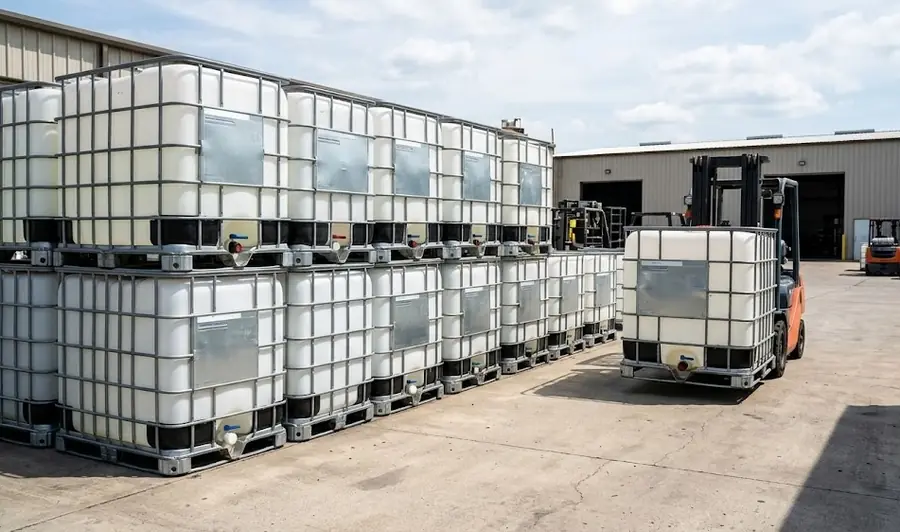
Carbon Offset Program
While our primary strategy for reducing carbon emissions is source reduction — reconditioning tanks instead of manufacturing new ones — we also invest in verified carbon offset programs to address the remaining emissions from our operations.
Forest Preservation Credits
We purchase verified carbon credits from forest preservation projects in the Pacific Northwest. These credits fund the protection of old-growth forests that would otherwise be logged, preserving their ability to sequester carbon for decades to come. Each credit represents one metric ton of CO₂ prevented from entering the atmosphere.
Methane Capture Projects
A portion of our offset investment goes to landfill methane capture projects. Since our mission is to keep tanks out of landfills, it is fitting that we also support technology that mitigates the environmental impact of materials that do end up in landfill — capturing methane gas before it escapes into the atmosphere.
Community Solar Initiatives
We contribute to community solar projects in Southern California that expand access to renewable energy for households and small businesses. These projects generate clean electricity that displaces fossil fuel generation on the grid, reducing overall regional emissions.
Annual Offset Audit
All carbon offset purchases are independently verified and audited annually. We publish the results in our annual sustainability report, including the specific projects funded, the number of credits purchased, and the third-party verification documentation. Our customers can be confident that their choice to work with EcoIBC has a real, measured environmental impact.
Future Sustainability Goals
Sustainability is a journey, not a destination. Here is where we are headed — concrete goals with target dates that will push us to be even better stewards of the environment.
Achieve 85% Water Recycling Rate
Upgrading our water treatment system with advanced membrane filtration to recover even more rinse water for reuse, pushing our recycling rate from 70% to 85%.
50% Renewable Energy
Completing our rooftop solar installation and supplementing with renewable energy credits to power at least half of our facility operations with clean energy.
Carbon Neutral Operations
Achieving net-zero carbon emissions for all facility operations through a combination of energy efficiency, renewable energy, and verified carbon offsets.
Electric Delivery Fleet
Transitioning our local delivery fleet to electric vehicles for zero-emission deliveries across the greater Los Angeles area.
Second Reconditioning Facility
Opening a second reconditioning facility in the Western United States to reduce shipping distances, lower transport emissions, and serve a wider customer base more efficiently.
25,000 Tanks Per Year
Scaling our operation to reclaim and recondition 25,000 IBC tanks annually — doubling our current throughput and proportionally doubling our environmental impact.
Sustainable Packaging & Shipping Practices
Our commitment to sustainability doesn't stop at the tanks themselves. We have implemented responsible practices across every aspect of our packaging and shipping operations.
Recycled Packaging Materials
All shipping boxes, filler material, and wrapping used for accessories and replacement parts are made from recycled content. We use recycled cardboard, biodegradable packing peanuts, and paper-based tape to secure shipments.
Minimal Packaging Philosophy
IBC tanks are inherently robust — they don't need excessive packaging. We ship tanks as-is with minimal protective wrapping, reducing packaging waste by over 90% compared to standard industrial shipping practices.
Optimized Shipping Routes
We work with our logistics partners to consolidate shipments, optimize delivery routes, and maximize truck load efficiency. Fewer trips means less fuel consumed, less emissions generated, and lower costs passed along to our customers.
Pallet Reuse Program
Wooden pallets from incoming tanks are inspected, repaired if necessary, and reused for outgoing shipments. Pallets that are beyond repair are chipped locally for mulch rather than being sent to landfill.
Make Sustainability Part of Your Supply Chain
Choosing reconditioned IBC tanks is one of the easiest, most impactful steps you can take toward a greener operation.
Start the Conversation